Why SCIC
The best details are the ones you don’t see.
Handles drawn into negative space. Outlets that disappear. Storage inside tables and deep in the corners. Every SCIC collection is engineered in Parma as a system, so a kitchen holds more, works better and shows less.
Notes from Italy · filmed by Alicia Lo
Open everything.
When I am in Italy I open every drawer and every door myself. These are unpolished clips from my phone, the moments that made me stop. You would never know these details are there unless someone showed you.
The plumbing has a door.
Outside the SCIC Flagship on Via Durini during Milan Design Week. I opened every door on Rossena Outdoor, the outdoor kitchen in the Rossena family: the sink plumbing, a refrigerator, the gas, each behind a flush panel. Closed, it reads as one clean block of steel and teak.
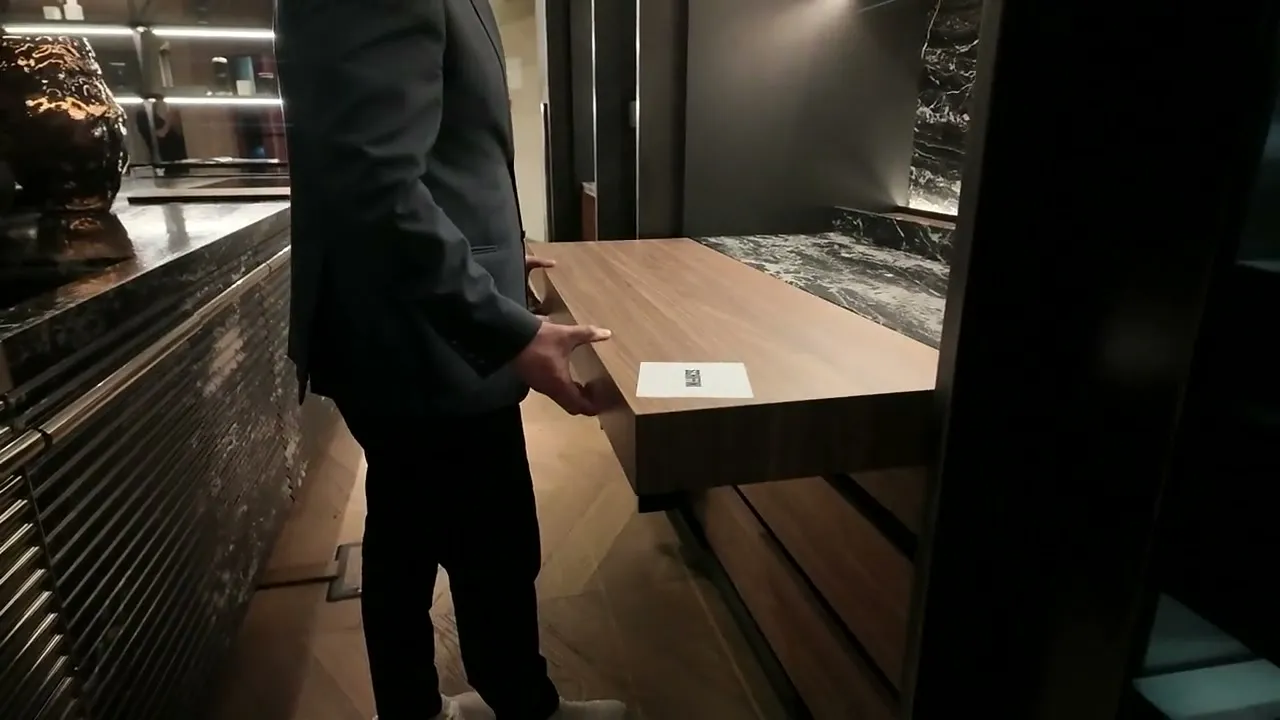
A table that lives inside the island.
The top slides out of the island and becomes a table, then slides back and disappears. No extra footprint, no extra piece of furniture.
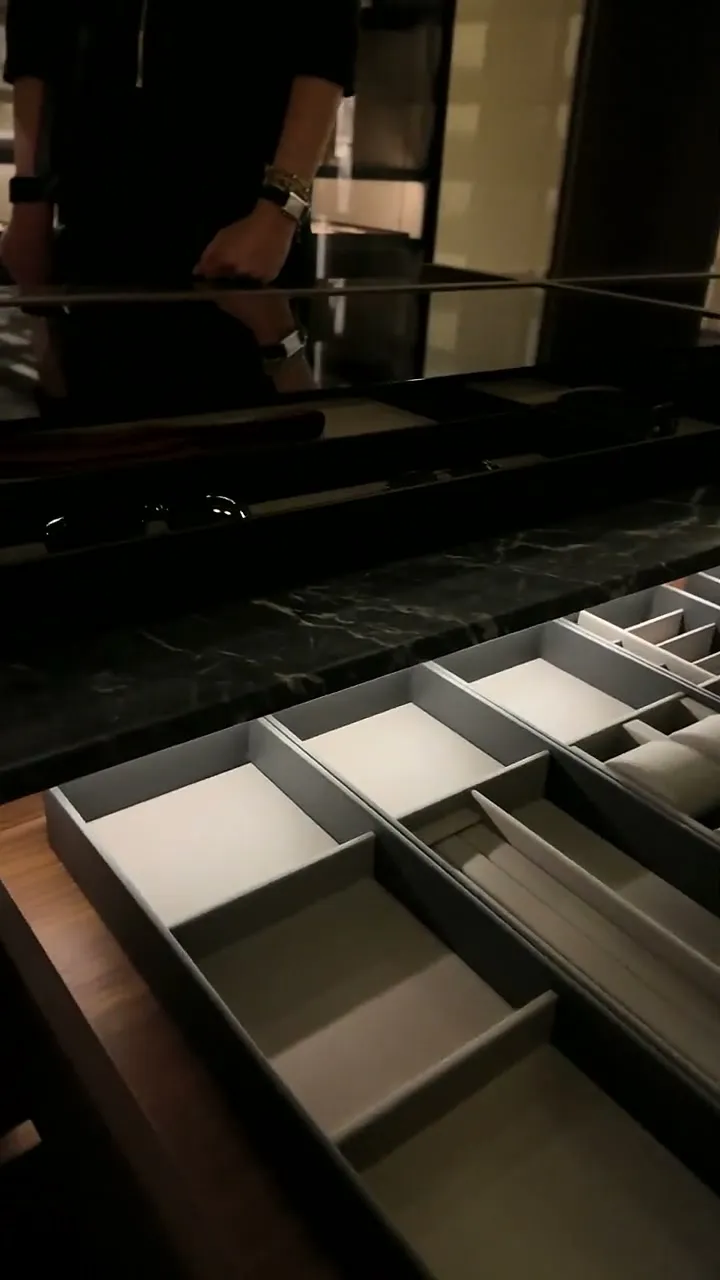
See it before you open it.
A dressing island with glass-top drawers and lined trays for watches and jewelry, so everything is visible and nothing is out.
No handles. The shadow is the handle.
The grip is a recess along the drawer line, negative space you find with your hand. Inside, the drawer is lined in colour.
A bar behind a plain wall.
Closed, it is a lacquered panel. Open, a lit bar with backlit marble and the glassware on display.
The refrigerator is behind the mirror.
Atrium, created with Conte Casa. The antique-mirror doors open to full-height refrigeration, and the dishwasher pulls out below. Closed, it is a wall of mirror and marble.
A pantry behind one door.
The tall door on the Atrium kitchen opens to pantry shelves that pull out to meet you. Closed, it is one flush panel.
Drawers inside a drawer.
Schiffini. Behind one stone front sits a stack of inner drawers: shallow trays above, deeper storage below. Closed, you see only the slab.
Fluted steel, lined in red.
Schiffini. A fluted stainless steel island whose drawers open to red-lined organizers for jars and utensils.
Filmed on my phone in Italy, 2025 and 2026. Unedited apart from trimming.
At Division Street
Ask us to open it.
The engineering sits behind the doors, so the room can be calm. Which details are available depends on the collection; we show you each one in the full-scale installations.
- 01
The handle is negative space
A recess or a shadow line instead of hardware on the front.
- 02
Outlets you don’t see
Covers designed to disappear into the backsplash and worktop.
- 03
Storage inside the table
Tables and islands that slide, open and store.
- 04
Corners that give back
Corner units that use the full depth a standard corner wastes.
- 05
Finishes engineered in Parma
Lacquers applied by SCIC’s artisanal process, so no two doors are quite identical.
For designers who have a carpenter they trust
A local workshop, or SCIC?
The Bay Area has fine craftsmen. The difference is not skill. It is the starting point, and how much you can see and test before your client commits.
It is checked here first
We inspect every piece as it comes off the container, before it reaches your site.
Planned in your drawings
We plan the modules within your architectural set and resolve appliance and technical details before production.
31 homes on Yerba Buena Island
SCIC San Francisco delivered the cabinetry for 31 luxury homes at Yerba Buena Island. See the projects
Sources: SCIC 2026 Company Profile; SCIC, Sustainability and certifications.
On materials
Why we don’t use solid wood.
Clients sometimes ask for solid wood, believing it is the luxury choice. For a kitchen, it is the wrong one. Wood takes on moisture from the air and gives it back, swelling and shrinking across its width with the seasons. Finishes slow that exchange but cannot stop it, and the movement can end in warping, checking and splitting.
A wide solid panel, whether a slab door, a tall end panel or a drawer front, is exactly where that movement shows. Doors cup, the reveals drift out of true, and drawers and push-to-open mechanisms stop lining up. In a kitchen engineered to the millimeter, a warped panel is not character. It is a kitchen that no longer works, and a bad look in a luxury home.
Veneer is the correct finish. SCIC uses real wood veneer over a stable engineered core: genuine wood you see and touch, on a panel that stays flat and true. It does not make the kitchen less. It is what keeps the kitchen working.
Read the full explanation: why veneer, not solid wood →
Veneer is one finish among many. SCIC kitchens are also finished in stainless steel, leather, brass, Liquid Steel lacquer, fluted walnut, stone, lava stone, ceramic and glass.
Sources: USDA Forest Products Laboratory, Wood Handbook, ch. 4 and ch. 12.
Among Italian brands
Why fashion houses trust SCIC.
Every fashion-house collection we present is produced by SCIC in Parma. Houses that guard their names this closely choose their maker with care, and they come to SCIC for the same thing your clients do: engineering that lets the design stay quiet.
Produced by SCIC
The ELIE SAAB Maison and KARL LAGERFELD Maison kitchen and wardrobe collections are produced with SCIC, in SCIC’s own facility in Viarolo di Parma. Maisons
One factory, every room
Kitchens, wardrobes, closets, bars and media walls from the same Parma facility, with finishes that carry from room to room.
Pagani Residences
Schiffini, the legendary hundred-year-old Italian kitchen house that SCIC stewards, designed the kitchens for every residence of the first Pagani-branded tower in Miami.
EDIDA 2026
Cina by Vico Magistretti for Schiffini won the ELLE DECO International Design Award for kitchens. Cina
Sources: Schiffini, EDIDA 2026, SCIC 2026 Company Profile.
For architects and interior designers
The SCIC Trade Program.
Many designers don’t know we have one. It is built for firms that specify for their clients, and it starts with a private presentation at Division Street.
- Complimentary private presentation and tour of the installations
- Drawing coordination within your architectural set
- Photo-realistic, to-scale renderings with finish alternates
- One point of contact from first drawing to delivery
- Client evenings at the showroom
- Trade terms for your firm, shared personally. Reach out to Alicia Lo
For trade terms, contact Alicia Lo at info@scicsanfrancisco.com or 415-595-1862.